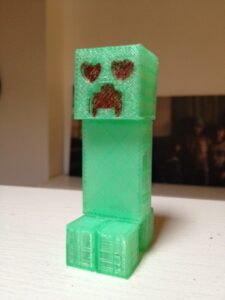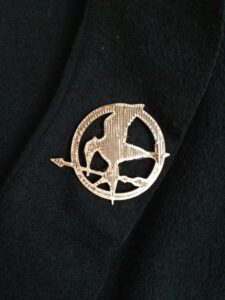
For Philly Tech Week, I will be showing visitors how to take a shape from Adobe Illustrator into the popular open source CAD program OpenSCAD and make a 3D model suitable for 3D printing.

Draw in Illustrator, extruded in OpenSCAD

Draw in Illustrator, extruded in OpenSCAD

I’m sure you know Illustrator. It’s the most successful vector drawing program <clarkson>in the world.</clarkson> OpenSCAD is less well known. It is best described as coding for objects. You make a solid with the function cube() and cut a cylinder() out of it with the difference() function, etc. But sometimes you want a more organic or complicated shape to start with. That’s where artist JK Keller stepped in and made a script that automates some of the process for you. What you need for this workshop:

There may not be time to print everyone’s design, but you should go home with something 3D printed.

Monday 4/22 5pm – 10
Gratis and Libre (free)

Hive76, suite 519
915 Spring Garden St
Philadelphia PA 19123

RSVP by commenting below.

Tagged with:
 

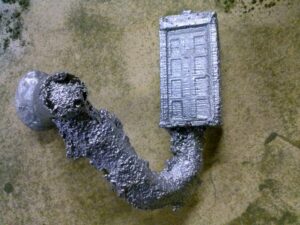
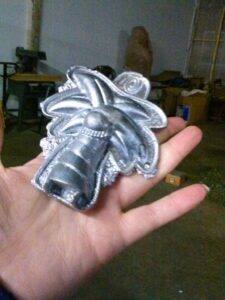
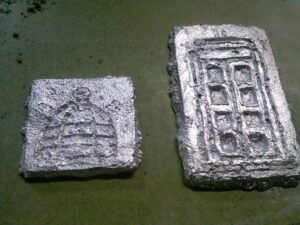
Lately, a few members have been discussing the use of 3D printed parts in use with metal casting techniques to create some stronger, lighter and more durable parts. As all good hackerspace conversations do, we immediately decided to go with the most painful and difficult solution: Metal Casting. Luckily for us the very next day, we got an e-mail that a local group, Philadelphia Sculpture Gym, that they intended on hosting an aluminium greensand casting class. A perfect opportunity to learn some metal casting techniques, even if not totally applicable to what we wanted to ultimately end up casting. Andrew S., and myself both signed up along with a few friends of Hive76.

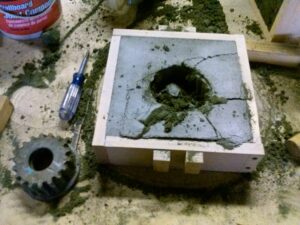
About 30 minutes into making our own greensand molds, we realized that this was going to be a difficult process, and immediately destroyed several hours of work trying to get a good crisp mold for our first pour.

Broken Greensand Mold

A simple gear was too difficult

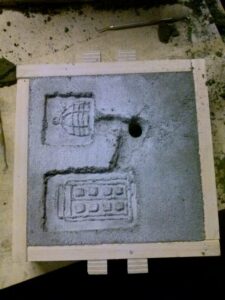
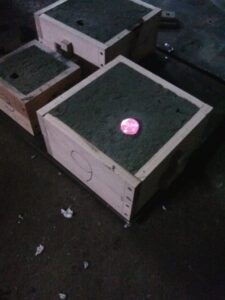
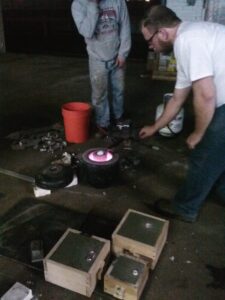
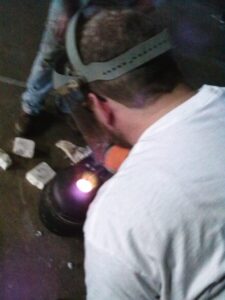
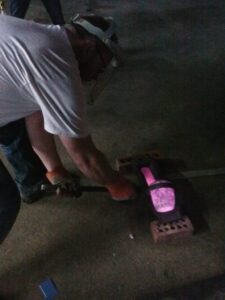
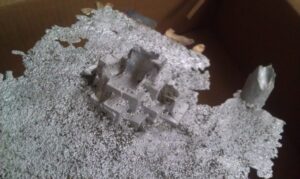
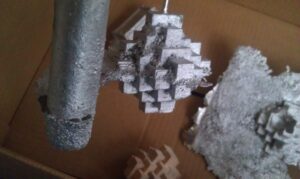
Several hours into our class, we managed to finally get a good solid mold of a 3D printed TARDIS. We hopped in line and got a pretty good looking cast. Andrew also attempted the TARDIS with some success. He also managed to get some good casts of a wooden puzzle, including one that blew out. However, due to our earlier troubles, we decided to hedge our bets and get one more good pour out of the class before we would start wrapping up. While waiting to pour ours, I was being shown how to work the furnace by Gus, and ended up melting down plenty of scrap and helping others make their pours which was a lot of fun to be working with. The furnace was operating at about 1300 Celsius, and moving around molten metal at that temperature can be quite a thrill. We plan on working with Gus and Darla at Philadelphia Sculpture Gym on some other types of casting techniques, especially as they apply to our 3D printing. We look forward to working with them in the future, and hope you all consider taking their next Greensand class in January.


Make Things Awesome(ly Scented)

I’ve been wanting to teach a class on how to make DIY/handmade personal care products for a while (a long while) now. Now, finally, it is happening! On Sunday, December 2nd, from 12-2:30pm, come learn how to craft your own personal care/beauty products from all natural ingredients! Together we will create a variety of body care products– such as aluminum-free deodorant, fabric softener, lip balms, and hand salves– using simple, inexpensive recipes composed of non-toxic materials like cornstarch, olive and coconut oils, beeswax, dried herbs, honey, and essential oils. We will also learn how benign, common household ingredients like baking soda, vinegar, salt, lemon, and hydrogen peroxide can be used to effectively clean around the home. Everyone will leave the class with their own handmade samples of lip balm, deodorant, fabric softener/scented sachet, and hand salve. Sounds like fun, doesn’t it?  I’m super excited to share the processes, recipes, and resources I’ve come across/developed/tweaked over the past couple of years of making my own personal care and cleaning products. Not only is it a fun way to spend an afternoon, but it feels empowering to have control and awareness of what goes on your body. I’ll be showing you just a few more ways that you can avoid consuming—and embrace making—in other aspects of your life!

Added bonus: these easy-to-make products can be re-created on your own to be used as gifts for the upcoming holiday season!!

All Natural Handmade Personal Care Products Class

Sunday, December 2, 2012, 12:00PM – 2:30PM

Hive76, 915 Spring Garden St, Philadelphia, PA 19123

$25 (includes all materials…but feel free to bring your own essential oil if you have a specific signature scent!)


Tagged with:
 

Hive76′s own PJ Santoro will be doing the “Main Presentation” at

the Philadelphia Area Computer Society‘s kickoff meeting, Saturday,

September 15th.

His topic will be “Arduino: Where It’s Been, Where It’s Headed, and Why You Should Care”.

After the main presentation, a beginner class will be taught in the Linux SIG.

PACS Schedule available here.

 
http://www.tvbgone.com/images/trippyRGB_images/35b-power-on.jpg

Trippy RGB Waves Kit

Soldering is an essential skill to learn if you’d like to build your own electronic circuits. Come on in to Hive76 and we can teach you how to solder using Mitch Altman’s Trippy RGB Waves kit!

This specific circuit has a red-green-blue (RGB) LED that slowly changes colors over time. When you wave an object (like your hand) over it, you reset the color-changing pattern. With several boards laid out before you, this creates a wave-like effect.

You can check out a video of the circuit in action here!

When: Saturday, September 8th, 1-4PM

Where: Hive76

Cost: $20 (covers kit and instruction)


Huzzah!

I know I certainly had a really fun time last night with everyone.

To recap, we did a walk through the Pong example (play it here, or read the code here) and saw a lot of things that are common to games programming. We looked at some ways that simple changes to specific values can have a huge impact on the look and feel of the game. We discussed the discovery process of programming and how integral the act of testing is to finding good gameplay elements. And we discussed some tools and habits that are good to learn to be a more effective programmer.
I want to get everyone started with playing with code as quickly as possible now. The more you do, the more you will learn. There have been tons of times in my career that I’ve pontificated on how to do something with no good result coming from mere speculation, only to be able to figure it out within minutes by just trying it. So with that in mind:
 

Game Programming: A Pong Clone

Class Time!

Tonight is the first lab session for our series on learning how to program in study of games with JavaScript. Can’t wait to see everyone here in just a few hours!

Additionally, for anyone who couldn’t make the weeknight-at-7pm time slot, I’ve cleared some time this Sunday to do a repeat/additional session–Sunday, August 12th, at 3pm. You can get tickets here: https://www.wepay.com/events/intro-to-game-programming-with-javascript-weekend-edition

Or hell, just click the button:
Sunday, August 12th, 3pm – 5pm, @ Hive76 Register

Pong!

The first game is, as promised, Pong. You can see the game in action here: http://wedusc.com/games/pong.html

And you can read the source code online in my GitHub repository here: https://github.com/capnmidnight/JS_Game_Programming_Class/blob/master/pong.html

I’ll have printouts for everyone when you get here. If this is your first time trying to read code, try not to cross your eyes too much. We’ll cover how to read code along the way.

Though this game is pretty simple, it has a few interesting features…

(more…)


Only 5 Tickets Left!

Wow, these things are selling a lot faster than I expected. There is still a week left and most of the tickets are gone. If you’re still interested, you should hurry and buy one to secure your place. If you are interested but can’t make it to Monday, August 6th, leave a comment on what dates would work better as I’m looking to have an alternate class schedule as well.

Some Q/A

A few questions came up in the last post, so here are some answers summarized for anyone who doesn’t read blog-post comments.

  • What time is the class? The class starts at 7pm on Monday, August 6th, 2012.
  • Can I just show up? I would prefer if you signed up for a ticket first, so I know how many people are coming.
  • Is there anything we should have/know before the class? You’ll need your own laptop computer, we don’t have enough public computers to go around at Hive. I will briefly cover some options for text editors in a blog post or at the beginning of the class, but if you already have a favorite text editor like Notepad++, Gvim, or TextMate, then by all means use that. Also, it would be advantageous for you to setup some sort of webspace. There are some free places like 110mb.com, or you could even use the Public folder if you have a Dropbox account, which is quite convenient.
  • Is it just JavaScript in general, or does it include HTML 5 and Canvas? Various HTML 5 techs will definitely be covered, eventually. You can’t really do much graphically without it. JavaScript, HTML 5, and CSS 3 all go hand-in-hand. While there are some Dynamic HTML stuff that can be done (and we will certainly cover it just because DOM manipulation is a good skill to have), eventually Canvas and Audio are a necessities.
  • Why not do <insert language> instead? That’s a really big question…
 

I have been using OpenSCAD to design the objects I 3D print these days. Take for example my printed towel rack pictured here.

3D printed Towel Rack

3D printed Towel Rack

The design is parametric, which means that each aspect of the design is customizable. I had a specific diameter rod to use, so I entered that value into the code. If you would like to make your own towel rod, you could download the code that I wrote, and change the diameter of whatever rod you find to use. In this way the design can meet everyone’s needs with very little effort. This also means that sharing the design is much more valuable for others.

In this class you will learn the basics of OpenSCAD and reproduce a simple design from scratch. Some prior knowledge is required; basically that when you code, you need to spell things right and close brackets. OpenSCAD is fully cross platform and easy to install. Feel free to bring an idea for a 3D printed object, but make it practical. OpenSCAD does not excel at organic pretty things. (more…)


Zen and the art of soldering …

This Friday, we were able to inaugurate our newly completed class space with a most auspicious visitor — Mitch Altman!

PJ, Brendan, Robert et al were working until the wee hours the night before making sure that the space was ready to rock — and it was — literally.

Mitch arrived a bit before the appointed time, snapped a few photos, schmoozed, chowed down some local Chinese food etc. and, while documenting our stash of Elephant Heads,

Even this Diavolino was glad to see Mitch

anointed Hive76 as the most organized hacker space he’s seen. Quartermaster Brendan took appropriate pride in the observation.

Mitch basically talked about the Maker/Hacker movement in general, showed some of the kits that were keeping him company on the train, and weaved it all in a thematic web reminiscent of Arlo Guthrie’s is-this-guy-rambling-no-holy-shit-he’s-a-genius-because-it-all-makes-sense-in-the-end style.

After that, everyone bought a kit or two and lost themselves in the task of soldering.  I don’t know whether it’s the solder fumes or just the act of soldering itself, but I felt pretty good at the end of it all.

The new space is completely awesome and turned out to be nearly perfect for the event. Hats off to Brendan, Robert, PJ and Jordan!