
How I Became a Maker

Probably the single most important decision about me that my parents made was to remove me from the institutional education systems and home school me. There was talk from my teachers of getting me diagnosed with Attention Deficit Disorder, but really I was just bored with my classes and had no socially acceptable concept of how to deal with that boredom (incidentally, I still don’t, but that’s a story for another day). Unfortunately for  Mom and Dad, they quickly learned that my disruptive, destructive tendencies would be visited upon them if they did not find ways to entertain me.

Enter: TOPS Science.

TOPS is brilliant. It’s a combination of comic book and pragmatic science lab. Everything in a TOPS science workbook can be done with house hold items. The topics cover a wide range: electricity, chemistry, biology, geology, meteorology–I wouldn’t be surprised if they eventually came out with a nuclear physics issue. I couldn’t get enough of them.

The materials were always simple, and something you probably had lying around anyway. For example, the electric circuits module used aluminum foil backed with scotch tape for wires, paper clips to connect them, and clothesline clips and rubber bands to make a flashlight bulb holder. There were never any exotic parts or chemicals in a TOPS module, and if something was slightly out of the ordinary, it would show you a convenient source for scavenging it from some thing else.

Even after all of the worksheets were done, I would still continue to play with the left over pieces, hooking up DC motors vultured from broken toys, making LEGO gears, testing out rubber-band belt drives, building switches made from bent-up paper clips and aluminum foil, and winding solenoids from ballpoint pens and wire from who-knows-where.

Some things that resulted from a combination of my boredom, ingenuity, and youthful ignorance:

  • A small catapult with a surprisingly long range and a poorly thought-out target area (i.e., a plate glass window).
  • A coil gun that scared the family dog into knocking over a ceramic vase.
  • Experiments in electrolyzing water for basic hydrogen and oxygen that resulted in several toxic chemicals as well as one small explosion.
  • Experiments in electroplating objects with metal from nails and paper clips that looked suspiciously a lot like the previous entry with largely the same results.

It was that second, small explosion that prompted my parents to buy me a computer as a compromise to prevent me from continuing with my increasingly dangerous pursuits in the physical sciences. But, I still carry the basic principles of analog circuits because of these awesome, little books. I don’t know what I ever did to deserve them because it would often lead to new ways for me to endanger my life/the carpet, but they are perhaps the most significant part of how I came to be a builder and maker of things.

Open Source Orbital Shaker

Open Source Orbital Shaker

Here is my entry for the Open Call for Open Science Equipment Contest.

I did this with help from Mike, Jack, Rob, Adam and others right here at Hive76. Thanks everyone!

Details and all source files for this project are available on Thingiverse.

The deadline for submission is December 15th, so if you have an idea for open source equipment you still have some time to submit your entry to the contest!

Open Source Orbital Shaker from jmil on Vimeo.

Join us for Open Art Studio this Weekend!

Chris building a BoomCase

Our entire building at 915 Spring Garden is taking part in Open Art Studios this weekend, and we’ll be there too!

Almost 30 studios will be open to the public, including Hive76! There’s a ton of different medias people use, everything from textiles to clays to electronics.

Come join us on Saturday and Sunday, December 4th and 5th, from noon – 5 pm at Hive76. We’ll also be upgrading our MakerBot with a new MK5 Extruder so we’ll be printing in tip-top shape again soon!

Open House, December 1st, 2010

a simple motor
a simple motor

We enter the cold, dark days of December with a super Open House meeting. As always, the night starts off with our 7pm Scrum stand-up meeting for members to update everyone on the progress of their projects. 8pm starts the official Open House, with pizza, soda, and snacks.

Keeping in our new tradition of “mini projects for open houses”, Adam and Jack will be showing everyone the basics of building electric motors. Previous open houses covered Glowsticks and Bristle Bots. Building simple motors is really a lot easier than you might initially think. Hand-made electric motors are a fun way to learn basic principles of circuits as well as a handy skill for any project that needs a little movement. Come on down and play with electromagnetic fields with us!

Toys that made me a maker

Pipeworks wrench
Pipeworks wrench

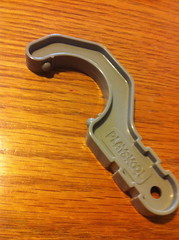
I visited my parents at home this Thanksgiving in Hillsborough, NJ and rummaged around the house I grew up in. One of the things I found was a Pipeworks wrench from my childhood tinkering. Pipeworks was a wonderful system that used basic PVC pipes with special connectors to make 90º and 45º angles and seat to snap in. They were like LEGO furniture. I created a wheelbarrow and lemonade stand as in the instructions, but of course quickly moved on to my own designs. The last and best being a small cart I dragged around on my bike until it fell apart. Here’s a video of kid actors having fun with the set. Good times.

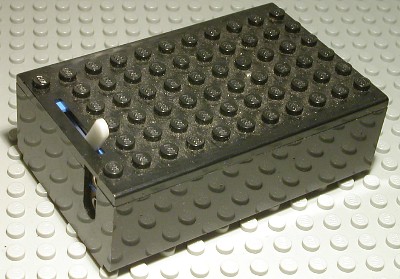
Of course, the Pipeworks were only one in a string of awesome toys that encouraged making. As any kid, I had LEGO (that is the proper collective noun apparently.) A true LEGO collection is measured in mass, and I still have about 40lbs of LEGO in my parent’s attic; the ABS plastic withstanding the seasonal temperature shift, but the forgotten batteries corroding the contacts of the battery box in my super-awesome death robot on wheels.

Construx helicopter
Construx helicopter

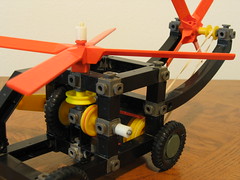
But every kid had LEGO. I also fondly remember the more obscure Construx. This set was like a smaller Pipeworks with beams that could be connected to make stuff. I had a set like the one pictured here with pulleys and wheels, and I kind of remember breaking those beams quite often with the wrong amount of torsion. It was very architectural though.

I had some K’nex too, another beam toy, but a bit more flexible and durable than Construx. K’nex came out in 1993, and by the time I got some, it was a bit too late for my tinkering age. I was sliding into the deep abyss of adolescence and the darkness of CompuServe image boards.

As a kindergartner I would also play with the lacquered wood blocks at Grandma and Grandpa’s house. Grandma had a special set of blocks that she kept high on the mantle away from kids hands. They were heavy stone and rounded from years of play; she played with them when she was a kid. It’s amazing that while researching this post, I found those same blocks: Anchor Blocks, or Anker-Steinbaukasten as they are known as in Germany where they are still made. They are quite expensive now too. Is this the best present for my pieces and nephews? Maybe they can share a set.

Zaks
Zaks

There was also a crazy toy called Zaks that I had a bag of. Zaks are equilateral triangles and squares that snap together at the edge. When completed, these polyhedral models look a bit like the STL mesh files I build today with the makerbot at Hive76. What made this set especially cool was that some pieces has a 4-stud LEGO pattern on them that allowed for easy attachement to LEGO models. I don’t know why I didn’t use this mind-blowing connection more in my models, but I remembered it just fine. Maybe I didn’t want to get my toys mixed up. I should have been building super intensive toys with Construx and the frame, Zaks, the moveable skin over a upper skeleton of K’nex with all the inner workings and details handled by LEGO attached to the top of a Pipeworks cart. Sigh. These are the regrets of a youth misspent. Today you can print out a Duplo block to Brio track adapter which to me seems like the greatest thing in the world. I wonder if I can print a Zaks-Construx adapter, or a new line of Pipeworks connectors with LEGO studs …

I got to get to work making stuff!

Tiny Terminal Using MSP430 and HD44780 Display

We have dozens of these HD44780-based LCD displays — now we just gotta make some use of them.  Here’s an experiment using an MSP430 to create a display that can be written to using serial data.  The displays actually have chips in them that can send the data as a differential signal (a la RS422), so it should be possible to send the serial over great distances if needed. The displays are also waterproof and have a six key membrane keyboard built in.  With the addition of a $1 MSP430, the setup turns out to be a pretty sweet building block …

A preliminary version of the HD44780 library for MSP430s is available here.

Multithreaded Banjo Dinosaur Knitting Adventure 2D Extreme

Along with being highly neighborly, and slightly insane Travis Goodspeed is also great reverse engineer. He is consistently a bringer-of-weird things to conferences (and the parties that inevitably follow). Many of those cool & weird things are objects designs and/or builds himself.

So It’s not a huge surprise to see him hacking on an amazing collaborative project to make an interactive tapestry creating game. As far as I can tell, as people play the game the winners custom designed image is added to the end of the tapestry. The game appears to be an scroller/shooter game, which is controlled by waving around RFID tags. Geez. And here I was, thinking having #15 high score on Hive’s Spy Hunter machine was cool. One more amazing projects from an awesome Philly resident.

Hive76 is on NPR!

No Joke! Jon Kalish from NPR visited our space for a raucous open house last month, and witnessed the amazing font of Chaos that is Hive76. This week, he featured us in his Weekend Edition piece about American hackerspaces!  Whoot! The segment features Brendan and Chris’ boombox suitcase, Chris’ Meatcards, and Jack’s USB Typewriter, among other great Hive76 projects.  Have a listen and hack on!

Bristle Bots

Tooth brushes, vibro-motors, and batteries, oh my!

For Wednesday’s Open House, we made little Bristle-Bots. A Bristle-Bot is a little robot consisting of a vibrating motor–similar to one found in a pager or cell phone–taped to a tooth brush head, that runs around a table like a little rodent or insect. They’re really easy to make, a ton of fun to play with, and a great time to extend and hack.

The basic, smallest design:

http://www.youtube.com/watch?v=TPC-IC0RFo0

A larger motor needed two brush heads:

http://www.youtube.com/watch?v=67zDMdlS2hk

The bigger motors tended to drain the batteries really quickly:

http://www.youtube.com/watch?v=F5qLKNw4v6Y

This was probably the best one, the builder actually soldered parts of it together. It now lives on in the “Trophy Case”

http://www.youtube.com/watch?v=Y4Q1ezT_zds

Next time, we’ll be making Christmas decorations based on the MSP430 microcontroller.