How I Became A Maker

Growing up, my dad worked overseas for the State Department so we moved all over the Middle East. DaveI always wanted to know how everything worked, and my dad had a hint of an interest in electronics and other hobbies, but resources were always a little limited and there weren’t any skilled mentors I could learn as much as I wanted from. I recall spending a lot of time coming up with wacky invention ideas, most of which in hindsight are probably infeasible, but coming up with the ideas was always half the fun anyway. My dad would bring home articles from magazines on topics he thought I’d find interesting, like building simple robots, or making red jello lasers. Periodically I would get an inkling to try realizing one of my inventions and I would save up my allowance money, eventually putting together an order from a surplus catalog in the States. It would take 2 weeks for my snail-mail order to arrive there through the diplomatic pouch, and another 2 weeks to receive my parts, and as you can imagine of a young kid, I usually ended up getting bored with waiting and abandoned the original idea for something I could do much sooner. I had a great set of books, a silver hard-bound set called “How Things Work”, which was wonderful for fueling the inner mad scientist in me. In about 4th grade I remember spending a fair bit of time designing the space ship that I hoped would eventually rescue me from homework and school, and also allow me to explore and perhaps begin colonizing Titan, one of the moons of Saturn. (Needless to say, that one hasn’t panned out. Yet.)

I really had an interest in how almost everything worked, picking up as many things as I could. One day my dad brought home the first Magic Eye picture I’d ever seen, and after struggling with it for an hour it was an incredible feeling when the image of the earth finally popped out at me in all its 3D splendor, and I’d been bitten by the 3D bug. Living where I did, we didn’t have access to hardware stores or Radio Shack, but there were petrified forests, ripe with geodes and other marvels of geology that I loved to learn about. In slightly later years I learned some interesting things about chemistry, and am probably fairly lucky to have all of my fingers and toes. After figuring out how to make a surprisingly effective blowgun with quite nasty darts, I got a taste of what fun working with projectiles can be, going on in much later years to build a high-power rocket that is fired from a pneumatic cannon.

I was always interested in computers, and had a burning desire to learn how to write my own software. In elementary school I stumbled onto HyperCard (an incredible thing at the time), and I was off and running teaching myself some basics of algorithms, and writing simple tools and games. (I was never particularly interested in actually playing games, much preferring to explore and learn, or take things apart and dream of what I could do with the pieces.) Discovering programming was a bit of a boon for me, because it was a way of inventing for free — no materials to buy or wait for in the mail, no tools to wear out, if I could dream it and if I had the motivation, I could make it happen for nothing. From that point on I think I just assumed that I would go on to major in Computer Science when I got old enough. Little did I know that when that time came, I would abandon it after feeling like the educational system was beating all the fun out of it for me.

I’ve always found myself wanting to understand things, but having to teach myself. While that has been frustrating, usually taking much longer than simply being taught by an expert, I think it has been valuable for shaping how I approach challenges. Making things can be a puzzle, an adventure, or a game, and it’s so much more rewarding in the end than something you’ve bought or watched on TV.
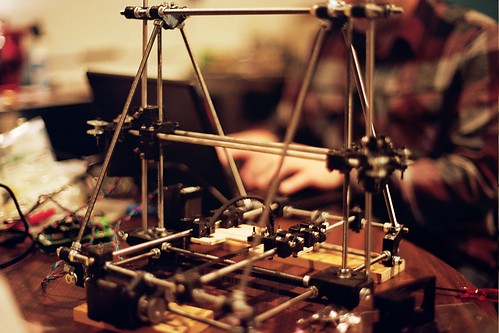
SloateBot: Prusa Mendel Lives!

The Prusa Mendel build is finally complete! Here’s a Stanford Bunny:

Prusa Mendel Bunny Print by jmil

PLA bushing sliding on precision ground 8 mm rods is actually quite smooth movement. I don’t think it can go as fast as the original Sells Mendel (which was ball bearings sliding over the rods), but it’s only half the printed parts and the z-axis is much smoother motion too. I will try oiling or greasing the bushings to try to get smoother and faster motion without losing steps. So definitely some tradeoffs but overall a super awesome bot. The Prusa is also fully parametric and entirely made from OpenSCAD. All sources are available on github FTW.

As this is the first bot I built that I actually own, I named this awesometown after my HS science teacher, Mr. Sloate, who really got me into Biology and now, robotics for Biology.

What will we print next?

Open House Wednesday: Bioplastic & LEDs

Starch Plastic

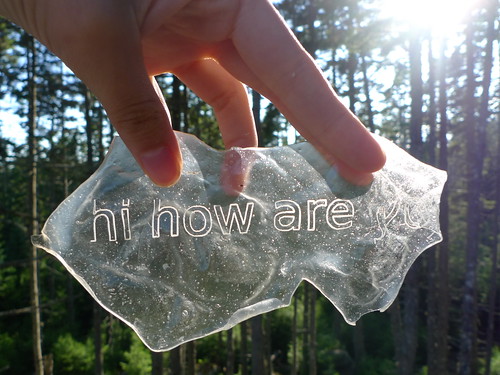
This Wednesday Mike and I will make some bioplastic from starch, water, glycerin, and vinegar. Then microwave it, squish it in a mold, and stick some LEDs in there. If you haven’t noticed, I like doing things for the sake of doing them and then maybe finding a use.

There will also be some blink & buzz supplies there and heart shaped molds for your people that care about hearts.

♥♥♥♥♥♥

Gitmarks 2.0 Alpha

As rumors of delicio.us shutdown rumbled through the internet, a bunch of geeks in a minor IRC channel started gabbing. They has a lot of info, links, tags, and data stored in delico.us, and were afraid to lose them, syncing, and all other good features. They realized as geeks often do, that if we owned the service, we wouldn’t have to worry about outside shutdowns if we had our own service. Thus hypatia spun-up Federated Bookmarks

The first output of this crew is something called gitmarks, based on work by Hillary Mason (of bit.ly). This is a little tool to store bookmarks, bookmark metadata, and page content locally for searching, using, and peer-to-peer sharing. Since it is based on git this system can use a central server, *or* it can share peer to peer. As the name implies, it uses a git backed for data transfer and versioning. It also has the ability to pull down content for a local cache, and for local searching.

This project is in Alpha, and if you want to test the silly thing, the basics work. If you want to help build a cool distributed tool, we could use some help! We need to building a server, building more git tools, xmmp messaging, and browser integration. We also hope to create tools that along the way that make it easy to build systems for Moglen Boxen. Ping [email protected], leave a comment here, or hit #hive76 in IRC if you want to help.

Hive76 Celebrates the Birth of Our Third 3D Printer!

Adam K. works on getting axis movement on the RepRap Huxley

Back in 2009, we ordered our first 3D printer, the MakerBot Cupcake. Since then, we’ve become pros at fixing, modifying, and mostly breaking it. We’ve even created new, awesome products for it which have been adopted by a good portion of the 3D printing community, and even sold by MakerBot themselves.

Shortly after completing our Makerbot, once-member fynflood decided to start building the RepRap Mendel, which is the 2nd generation of the RepRap Project’s 3D printer. He started by printing all of the pieces on our MakerBot, which took over 20 hours to complete, and gathered all of the required hardware with help from many of our members. A printer was born out of Hive76, and life was good. A few months later, there was a post on the reprap aggregation pipe about a new iteration of the reprap, called the Mendel Mini (now the RepRap Huxley), which has a similar build volume to the MakerBot, but can be assembled for under half the cost. Fynflood set out to print the parts on his Mendel, while I gathered all the required hardware and electronics. After a few months break over the summer, and a few more months being busy with the Holidays, the Huxley is now complete! Our printer’s baby made a baby!

At this very moment, we have 2 MakerBots and the Huxley all going at the same time at the space! If any more printers show up, we’ll probably have to start giving away USB Typewriters just to make room! Really, it’s an exciting time to be printing at Hive76, so if you have any interest in learning how 3D printers work, or even building your own, come by for open house on Wednesdays and check out all the awesome things we’re making!

Hit the jump for a few videos and images from the first few prints!

Continue reading “Hive76 Celebrates the Birth of Our Third 3D Printer!”

The Kids are Alright

This is probably just shameless nepotism under the guise of “DIY video”, but this video by my son Levi had me rolling.  The video camera, computer and editing software were great investments, in my book.

If you elect to watch, give it at least 30 seconds …

Weekend Itinerary

the Atari Punk Console

This is a busy weekend for Hive76, with classes and guest speakers and projects out the whazoo, so if you can manage to dig your way out of your snowy sarcophagus, come on down and see what’s happening.

  • Friday, Jan 28th – At 6pm tonight, we’re having a new member orientation meeting. This will be one of the first times we’ve had so many new people join at one time to warrant a specific “orientation”. This event is open to new members as well as any old ones who would like to get more involved at the space. Afterwards, we are going out to a nearby restaurant for dinner and drinks.
  • Saturday, Jan 29th – From 10am to 4pm we are running our “Making Things Blink and Buzz” class ($40, kit materials included) with Far McKon. This class is a hands-on workshop for building fun noisemakers without getting bogged down in drawn-out mathematics and electronics theory. A couple of seats still remain open and we do take last-minute entries if you are paying cash-at-the-door.
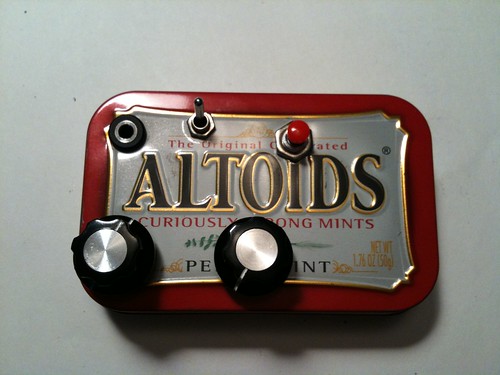
  • Sunday, Jan 30th – From 5PM to 8PM we are running a special open house for analog audio hacking. This is an open house for anyone of any skill level to mess with audio electronics. The event is free, you may bring your own materials, or beginner audio kits ($15 – $30) are available to get you started. A few very knowledgeable geeks—Jimmie P. Rogers, circuitbender and designer of a popular Atari Punk Console kit, and our very own Brendan Schrader, cohost of our Guitar Effects Class—are on hand to help out with more advanced projects.

This is just the start to our new year of classes and workshops. We have a few exciting events currently in planning stages, including a workshop on Rapid Prototyping and a series of workshops on Mixed Drinks and Molecular Gastronomy. Also, don’t forget our weekly open houses, every Wednesday at 8pm, where you can meet our current members, get to know everyone, and join our ranks yourself. Members get discounts on classes and kits!

(ed: snafu on list of attending “experts” fixed)

Audio House Open House

On January 30th from 5PM to 8PM is an Audio House Open House at Hive76. This is an open house for *anyone* of any skill level to mess with audio electronics. Whether you have never soldered before, or if you are an audio expert, we will have great folks to hang out and learn from. On hand will be some beginner audio kits ($15 – $30) for people just getting started, and a couple of knowledgeable geeks to help out on more advanced projects. What experts? I’m glad you asked.

Exhibit #1: If you have been to a Maker Fair in the last year, you might have run into Jimmie P Rogers and/or Mitch Altman running one of their famous electronics tables. Jimmie and Mitch have tough countless people to solder, and do basic electronics. Jimmie is also well known for his circuit bending, and can do things to a talking toys that, well, you just have to hear it to understand.

Exhibit #2: If you have been to Hive76 for an open house in the last few months, you may have run into Brendon, who is an analog electronics nut, and has run some effects building classes here at Hive76. The Guitar Effects class he and Jack ran was a hit, and he’s back to help make your projects sound fantastic.

So, young or old, geek or square, drop by Jan 30th between 5PM to 8PM, Hive76 will be open and both of those audio hackering experts will be on hand tou help people mash up circuits, tweak their audio, and get analog. If you like audio (from Novice to Expert) come drop in, hang around, and geek out.

When: Sunday Jan 30th from 5PM to 8PM
Where Hive76 HQ (915 Spring Garden St, Phila PA)
Cost: Free! (A $10 donation if you insist)
Equipment: Bring a project, a talking toy, or 20 -30$ if you want to buy a kit.
(photo by CC from Steve Dubois Thanks Steve!)