TIWrap makes your LaunchPad steak house handle like an Arduino bistro

We whipped up a Wiring-ish wrapper for the MSP430 a while back in order to simplify the task of porting Arduino libraries for use with MSP430 microcontrollers.  It turns out, we weren’t the only ones that thought of it.  PJ spotted a post on Hack A Day where someone unveiled something remarkably similar, and that post resulted in at least two other folks besides us posting their similar ideas — so there are at least four of these wrapper libraries out there.

Naturally, we’d like to think that ours is the best of the bunch, and the best named too — TIWrap.  Seriously, though, we seem to be genuinely different in that that we have bundled in actual libraries ported from Arduino, such as the HD44780 and MAX7221 libraries.  There are some piezo buzzer libraries and we expect to add some Charlieplexing utilities soon.  You can get a copy of TiWrap here.

The demo above is a “Fancy Flashlight” concept proposed by Matt Torbin.   It’s just one MSP430, two LEDs, a button and a bit of code which you can find in the TiWrap examples.

And in case the title left you puzzled …

March Philadelphia Robotics Group Meeting Wrap-Up

Hey guys,

Another great meeting of the Philadelphia Robotics Group has gone by and it was awesome! I must say that this has been one of our more populated meetings thus far (although not the most by a bit). In addition to regular Philly Robotics members and Hive 76 members, we had a few new people show up for the group, newish people coming back from the previous month, and even a returning member from long ago.

We talked about everything from Lady Ada and her beginner Arduino kits, the work being done on our own Web presence (phillyrobotics.org), to a project concerning a radio controlled Dalek (of Doctor Who fame).

All in all a great 3rd meeting for the year. See you all next month on the 14th!

Announcing Artemis Spaceship Bridge Simulator Night

Hey readers,

Artemis Spaceship Bridge Simulator has it’s own night at Hive 76 now! For all you trekkies out there, Artemis Spaceship Bridge Simulator is a networked multiplayer game that simulates a spaceship’s bridge; much like what you’d see on Star Trek®. We’ll be doing the event on the second Tuesday of each month, and our next game is… tomorrow (Tuesday, March 8th)! If you can make it, don’t forget to bring your laptop or netbook.

Artemis Spaceship Bridge Simulator Night
Hive 76 (915 Spring Garden)
Tuesday, March 8th @ 7:00 PM.

Engage!

Week of 3/2/11 Open House Recap

Howdy folks,

Last night’s open house was awesome. Some new people stopped by and that’s always great to see. The highlight of the night (at least for me) was doing karaoke again. Even when you’re screeching out of key, karaoke is always a good time.

See ya next week!

D-I-Y DCP Creation using OpenDCP

[Editor note: This is a guest post by the wonderful Chris Young. He’s making his own 3D short film from the ground up. -eagleapex]

terminal
My goal was to make OpenDCP work on a Sony SRX R-320 and after numerous attempts — as an independent filmmaker, I am elated to say it worked perfectly! It wouldn’t have been possible if Terrence Meiczinger hadn’t developed OpenDCP.

Admittedly, a few weeks ago I didn’t know much, if anything, about creating DCP files… let alone a stereoscopic 3D-DCP. I had recently finished work on a self produced and directed short film, “Dead of Nowhere”, that I was able to make largely in part utilizing the crowd-based funding site Indiegogo. I used a Final Cut Pro / 2K Cineform workflow to edit and finish my film. I shot my film guerilla style in one day, handheld on location with the Element Technica Dark-Country beamsplitter rig, recording to a 1-Beyond Wrangler. When I learned that it was going to cost somewhere between $1,500 and $3,000 to have my ten minute film encoded in order to have it shown in a realD™ equipped theater, I knew I had to find an alternate “indie” solution to create my DCP.

After investigating all of the commercial solutions (easyDCP, Doremi, etc.) and speaking with several “indie-friendly” post houses — all of whom bid out of my price range… I stumbled onto OpenDCP.

While the notion of using an open-source command-line tool, still in development, isn’t for the faint of heart, and I am by no means a Unix Pro, the process was pretty simple once I understood how the OpenDCP tools worked.

There have been plenty of how-to posts, so I won’t get into a lot of detail here… but basically after getting my film into a Left Eye / Right Eye TIFF sequence at the correct aspect ratio (1998 x 1080), the frame rate at (24p), ensuring that my audio was the exact same length (intrinsic value) and the correct sample rate (24bit), it was a fairly straight forward process to convert to XYZ jpeg2000 (.j2c) using opendcp_j2k and then using opendcp_mxf to wrap the stereoscopic-picture and main-audio elements into separate mxf files. After figuring out that I needed to be sure to have the digest (-d) and annotation (-a) tags set in opendcp_xml, it was then just a simple matter of getting these files onto a drive to load into a cinema server.

Now, don’t get me wrong, this will probably not work the first time. I had to make several trips back and forth to the theater, trying various DCP versions (interop and smpte) and hard drive formats (I settled on NTFS).

If you’re an indie-filmmaker, trying to get your film digitally packaged for exhibition and don’t have the money to spend, or are the kind of person (like me) that enjoys learning about every step of the process — I couldn’t recommend a better, more rewarding way of creating a DCP.

More information about OpenDCP and DEAD OF NOWHERE can be found here:
OpenDCP Link: http://code.google.com/p/opendcp/
Short Film: http://www.deadofnowhere.com
Facebook: http://www.facebook.com/deadofnowhere


Why I won’t be buying a new Mac any time soon

Apple gave everyone a new shiny thing to talk about today and I will not be left out of the discussion! Apple’s refreshed MacBook Pro contains a new Intel chipset Core i5 and i7, codenamed Sandy Bridge. Sandy Bridge chainOne lovely “feature” of this new processor is the Intel Insider built in to every Core i chip. This feature unlocks HD content playback on your machine for a limited time. Intel denies that this is DRM, and rightly so. DRM has been a hated buzzword among consumers and Apple alike. (No customer ever asks for more restrictions.) What Intel Insider has is worse: trusted computing, and for the worst reason too. It seems Hollywood has asked our biggest processor manufacturer to protect their business model with a feature that prevents streaming video from being recorded. Doesn’t that sound kind of unhinged?

Trusted computing is a hardware solution to the problem of trust. It has some noble goals. Your computer today may be exploited in some invisible way, but a trusted computing platform would verify all the code through it’s own protected hardware before allowing any software to run at all. The only way around this is to saw away at a encryption chip epoxied onto your motherboard. So, no malware is a good thing, right? That sounds fine until the keys to the computer are taken out of your hands and given to Hollywood/Intel/Apple/anyone-else because you, a de-facto pirate, can’t be trusted. Just wait until your repressive authorities request control of your shiny MacBook from Apple, and Apple acquiesces.

Add to that the recent processor recall, and it’s a scary time to buy new Mac hardware. Isn’t there room enough in the smart consumer market for some Linux hardware that Just Works? Today I’m one step closer to kicking my addiction for sandblasted aluminum and high-strength alkali-aluminosilicate glass.

Of course, I got all my opinions from the story 0wnz0red written Cory Doctorow for Salon.

Week of 2/23/11 Open House Recap

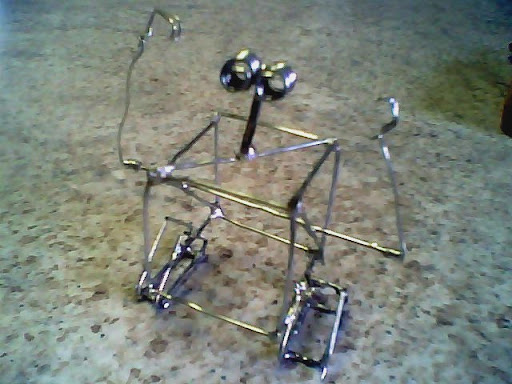
Tonight  was great. The space was busy with so many people working on so many different things. Including a public mini project where we made geometric figures out of paper clips and solder, and various 3D printing projects.

There were some pretty interesting discussions tonight too, ranging from urban exploration to video game development.

Also, and most excitingly, our very own Adam Kaufman showed off a new product that he’s been working on. More details to come.

Hope to see you there next week!

Open House, 2/23/2011

WALL-E!
WALL-E!

Tonight, we will be making geometric figures out of paper clips, jumper wire, and solder. It’s a fun way to practice your soldering skills, as some of the joints can be quite difficult to arrange.