Tonight at IndyHall: Cory Doctorow book reading and 3D printed sugar

We are cosponsoring Cory’s Pirate Cinema event at IndyHall tonight, but since there’s not much for Hive76 to do, we decided to make him a present. Here’s a video of production last night:

That’s a 3D printed sugar head! Cory’s excited to see it in person. You should be too! Come to IndyHall 22N 3rd at 7pm tonight. Here’s the Anyvite link to RSVP. We’ll be bringing a boomcase for the PA too.

The gritty details: That’s a Baricuda extruder using air pressure to extrude molten sugar. Now I need to figure out how he can get it home to the UK in one piece.

Fast JavaScript Game Loops

Change

Okay, so I’m going to switch over to a very simple format, with very short examples of how you do certain things. The long article format is just too much for everyone to digest and takes too much time for me to write, so I tend to put it off forever.

Types of Games

Most games fall into two patterns: turn-driven or time-driven.

Turn-driven games have distinct periods where user input is taken, then periods where game updates are made, and the two do not overlap in anyway. The user-input section waits for the user to make their choice, and the user then waits for the update section to finish before they take their next turn. Many puzzle games and most board games are going to be of this type. For example, in chess with an AI player, the game waits for the player to move a white piece. Once the player moves, the AI takes over and calculates a move for a black piece, during which time the player is stuck and cannot make any moves. Once the AI has moved the a black piece, it’s up to the player to make a move decision again, and the AI cannot progress until the user has decided.

Time-driven games work completely differently. They are constantly updating the game, never waiting for the user to first make a selection or hit a button or waggle their joystick. If a user does perform some kind of input, the input is not processed separately, it is taken into account for the next update. Think of a game of Asteroids, in which the big, giant rocks float around the screen all on their own until the user decides to turn her ship and blast them.

There is actually a third class of game called alternate-reality games (ARG) that do not really update and do not really take user input–not in the same way these other games do–but they are way outside of the scope of this project. ARGs are more literature projects than programming projects.

Turn-driven games are relatively simple to create, as the user drives everything and performance issues do not cause noticeable artifacts like frame-rate stutter or audio clipping and buzzing. When we get into handling user input, you’ll learn all you need to make turn-driven games. Actually, time-driven games turn out to have many of the same features as turn-driven games, just with the additional features of not waiting around for the user first, having its own pump to drive the game forward.

We will be focusing on time-driven games, as they are the most technically challenging.

Continue reading “Fast JavaScript Game Loops”
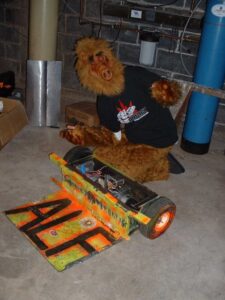
Fight, Robots, Fight! Built at Hive

The original ALF 120lb combat robot, 2005.

Many folks surely remember the days of fighting robots on TV: Battlebots, Robot Wars, Robotica, etc. And while its televised days are behind it, the sport is kept alive by groups of builders and competitors across the country. The Northeast Robotics Club (NERC) is just such a group, and one that I have been a member of since I first saw robots destroy and get destroyed on TV.

In the years since, I’ve traveled up and down the East Coast competing with robots of my own. But this past weekend, our own city of Philadelphia hosted NERC’s annual Franklin Cup, held in conjunction with the Franklin Institute. For this event I decided to continue the lineage of a long-standing family of NERC bots: ALF!

Now, this is the first robot I’ve built since I’ve moved to Philadelphia. My center-city apartment is about the size of a large phone booth and lacking any machine tools, so it’s obviously not a good workspace. The Hive, on the other hand, with its storage space, large work areas, and 24hr availability of tools and resources, was the perfect place to build. It may sound like a shameless plug, but the story of ALF would be incomplete without it.

Continue reading “Fight, Robots, Fight! Built at Hive”

Hive76 @ Maker Faire NYC 2012

Hive76 sure made the rounds at this year’s Maker Faire. With 2 tables in the 3D Printing Village, we had a steady stream of visitors both


days, ranging from Chocolateers, Digital Artists, to young children asking about 3D printing toys and parts for their projects. Discussion started about 10 minutes after we left Maker Faire for what to do next year. Check out the album for some quick snapshots of this year’s events including Karaoke, Thumb Wrestling, and of course, the occasional interview.

We are running a 3D printer race at Makerfaire

At Makerfaire in NYC this Saturday, Hive76 will be running a race to test the quality and speed of any 3D printers that would like to participate.

We will have an announcement and official start in the 3D Printer village at noon on Saturday. But the basic premise is this:

  • We will announce and post a 3D model on this page.
  • Racers will download and print the model in any material
  • The model will need to fit on a metal part and hold water
  • The first part to hold water without leaking for 5 minutes wins!
  • The prizes: a Math Watch by eagleApex (me) and a file to print your own trophy!
In summary, printing an accurate, water–tight part quickly will be a good balance of those three 3D printing goals.

Besides this 3D printer vs Man race, I think this is the first race of it’s kind! I hope you participate and I’ll see you there.

Update:

Here’s the file for the race!


Software Freedom Day @ PACS

Hive76’s own PJ Santoro will be doing the “Main Presentation” at

the Philadelphia Area Computer Society‘s kickoff meeting, Saturday,

September 15th.

His topic will be “Arduino: Where It’s Been, Where It’s Headed, and Why You Should Care”.

After the main presentation, a beginner class will be taught in the Linux SIG.

PACS Schedule available here.

We are in the Inquirer!

Tom Avril came for the awesome bioengineering work that Jordan did at Penn and Hive76, but he stayed to write an awesome article about us and the Philly hacking scene. Here is the awesome article that’s also on the front page. And below is the awesome video Inky photographer Clem Murray shot during one open house. Hack on!

Intro to Soldering Workshop

Soldering is an essential skill to learn if you’d like to build your own electronic circuits. Come on in to Hive76 and we can teach you how to solder using Mitch Altman’s Trippy RGB Waves kit!

This specific circuit has a red-green-blue (RGB) LED that slowly changes colors over time. When you wave an object (like your hand) over it, you reset the color-changing pattern. With several boards laid out before you, this creates a wave-like effect.

You can check out a video of the circuit in action here!

When: Saturday, September 8th, 1-4PM

Where: Hive76

Cost: $20 (covers kit and instruction)


Hive76 Welcomes Raspberry Pi Developer, Rob Bishop!

Rob Bishop, a developer with the Raspberry Pi Foundation, is going to be taking a short tour of US hackerspaces. We are pleased to announce that Hive76 has been included on that list!

Because we are expecting a very high level of interest in this event, we have decided that our studio space is a little too small to accomodate the number of people we are expecting to attend. Philadelphia’s University of the Arts has  graciously offered up some space for us to meet in. There are only 30 spots available, so act fast; this will sell out. Ticket purchased are limited to 2 per person. You’ll find the link below.

If you’ve been wanting to get a taste of the Raspberry Pi (:P), you will not want to miss this event. The event is free to the public, but space is limited! Rob will have Pi(s) for sale at $35 per board. They are still on back-order from major  distributors, so now is your chance to grab one!

Here is what to expect:

Rob Bishop from the RaspberryPi Foundation is touring popular hackspaces in the US throughout September 2012 with the aim of giving talks and workshops about the RaspberryPi to both the hackspace members and also RaspberryPi users in the local community.

The Raspberry Pi Foundation is a charitable organisation founded with the aim of promoting the study of computer science and related topics, especially at school level. The Foundation is responsible for the design and sales of the popular RaspberryPi single-board computer. You can find out more about the Foundation and the RaspberryPi here.

The event at each hackspace will informally consist of the following;

  • Talk:
    • RaspberryPi: Past, Present & Future – An introduction to the RaspberryPi, including an overview of its history and development, details on the technical specification and an outline of future developments with many cool tech demos along the way. Followed by a Q&A session.
  • Tech Demos:
    • A chance to demonstrate various OS’s and other demos
  • Workshop:
    •  A chance to play with the RaspberryPi hands-on.
  • Show & Tell / Prizes: 
    • An opportunity to display RaspberryPi projects from the community with prizes for notable projects.

The tour will be blogged/vlogged on the RaspberryPi website and we hope to attract RaspberryPi enthusiasts and hackers/makers from across the areas we will be visiting, allowing us to meet and support our community.

Here are the details on where we are meeting and at what time:

University of the Arts, Terra Hall, 5th floor

211 S. Broad Street, Philadelphia, PA 19102

Monday, September 24th, 7:00PM-10:00PM


Update: Corrected UArts address