Saturday September 17th, Hive76 members Chris and Peejay will be co-presenting at the Phila Area Computer Society’s Season Kickoff Software Freedom Day Extravaganza.
PACS meets at the Super Giant in Willow Grove, PA.
Saturday September 17th, Hive76 members Chris and Peejay will be co-presenting at the Phila Area Computer Society’s Season Kickoff Software Freedom Day Extravaganza.
PACS meets at the Super Giant in Willow Grove, PA.
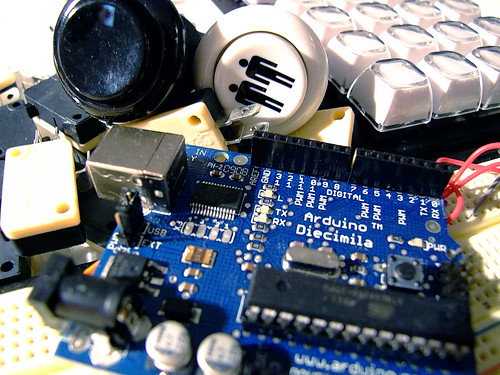
Starting at 7 PM on Monday, September 12, Hive76 will be starting a new ongoing monthly workshop focusing solely on the wonderful world of microcontrollers.
“What’s a microcontroller,” you ask? Let’s take a quick glance at the Wikipedia page!
“Yeah, so?? Why should I care?”
“What if I’m familiar with microcontrollers, and I’m just looking for a place to talk shop, jump-start a stalled project, or help other folks learn a thing or two?”
Great! Now that you’re coming, what can you expect?
You can expect to be welcomed into a friendly environment and you are encouraged to bring your ideas, aspirations, projects, and most importantly, your questions! Individual projects, group projects, build challenges, basic skill instruction, hardware buying guidance, and experts on hand! I would like to emphasize that this workshop is open to complete beginners. No prior experience with electronics OR programming needed! We’ve all got to start somewhere!
PIC, Basic Stamp, MSP430, Arduino, etc… no microcontrollers will be turned away! This is an all-inclusive, open workshop to promote learning!
The Fine Print: Materials will be available for use within the space and a limited amount of hardware will be available for purchase. If you’ve got a laptop or netbook handy, please bring it along. Instruction and guidance will be available free of charge!
(Donations are always appreciated)
This workshop is brought to you by: KBI, Inc.
For Wednesday’s Open House, we experimented with using simple, house-hold items to etch common, metallic objects. We found that candle wax, melted in a thin layer on the surface to be etched, worked as an excellent resist material. The firmness of the wax helped to keep the scratch lines straight, while the thickness of the paperclip made for a consistent stroke. We also tried acrylic paint as the resist, but it quickly dissolved under the cotton swab. We also tried the ink of a permanent “Sharpie” marker, but that was also easily dissolved under the cotton swab. We had other resist materials available to us, but these were the only ones that were “household” items.
Once the resist is set and the design is scraped out of the resist, the anode (negative terminal) of a 9v battery is attached to a bare metal area of the object, and the cathode (positive terminal) is attached to a cotton swab soaked with very salty (NaCl, common table salt) water. Within a few seconds, the electrolysis process creates a weak hydrochloric acid solution that eats away the steel of the object. After etching to the desired depth, the polarity of the connections can be reversed to oxidize the bare metal, as the now-anode cotton swab will produce oxygen molecules out of the electrolised water.
Here are some photos of our efforts.


In addition to the electro-etching, we also had some fun toys to play with.


And then I just had fun taking photos of stuff.


Stop by next time when we bust out the big guns and… it’s a secret! Come by and find out!
Thanks to all who attended our first stereo photography class, it was a great turnout with several new faces! If you attended, here is some content that I just created that you can view using either the anaglyph glasses or parallel-viewing stereopticon that you received, or if you have been practicing up on your free-viewing, you can use the cross-eye method or “look-through” method (just set the 3D settings appropriately towards the bottom of the video on YouTube). I’ve created a slideshow of 3D images captured using wide baselines — in other words, the two photos making up each 3D picture were taken very far apart, much farther apart than the distance between a human’s eyes.
So, why wide-baseline? Well, the sense of depth from stereo vision is highly nonlinear, so we generally have exceptional depth perception up close (within a few inches or feet), but we are able to differentiate less and less as the objects get further away. In everyday life our depth perception due to binocular disparity is basically limited to around 20′ or so for most practical purposes. (This is why 3D pictures of landscapes are usually extremely boring and flat — the subject is too far away to make out the depth!) However, it is possible to overcome this limitation by moving the two cameras (one for each eye) farther apart. Some of these images were taken from airplane windows hundreds or thousands of feet apart, making it possible to discern depth between cloud layers many miles away. This tends to produce an effect that is similar to examining a miniature model of the subject up close.
Most of these 3D pictures were captured with the video camera on my phone while on a moving platform (train, car, airplane, etc), with the camera held very still up against the window and facing directly out. I would then open up two copies of the captured video side by side and use the cross-eye method to find two frames of the same subject that provide good depth. I would then copy those frames into Gimp, align the images and crop them down to produce a finished stereogram. It takes time and practice but it can produce some really cool results!


We had some questions about provisional and full patent applications. Here’s some notes we got from a while back talking to a patent attorney.
In general, US Patents cost ~$10-25,000.
In the US, the right to hold a patent is based on a “first to invent” policy. Example: Bob invents something. At a later time, Jim invents something identical and files for a patent. Bob later files for a patent. Jim’s patent will be rejected and Bob will get the patent because he invented it first (assuming he has proof). Proof of invention is typically a notebook or extremely detailed record of the invention. It does not necessarily need to be “the idea sent to yourself by certified mail.” Sending the idea to yourself by certified mail is not necessary for certifying invention date, but can sometimes be useful to prove that you have “prior art” to invalidate someone else’s patent.
The reason to do a simultaneous international filing is that the US is the only country that is first-to-invent. All other countries are first-to-file. Meaning that if you file in US only, and someone in another country sees your patent (the submissions become public in 6 months, well before the patents are granted or the provisional 1-year deadline gets close), then you can actually lose rights to the patent in other countries and their patent will supersede yours in those countries. You really want to do the filing here.
Normal trade-secret laws can be used to protect your idea without having to do anything else as long as you don’t disclose the idea to someone not under NDA. This means that writing a detailed account of your invention and keeping it locked up is enough to protect yourself. Get a good notebook, keep very detailed notes, date and sign every page, and keep the notebook somewhere safe. If someone breaks in and steals your idea, this situation falls under normal trade-secret laws, and you are protected. The only way to protect an idea after non-NDA disclosure is to submit a patent application within one year.
In the US, there is a 1 yr “on-sale or bar date” limit. An individual has exactly 1 year from the date of public disclosure of his invention to file a patent. This is a very strict limit. If a patent application has not been filed by this date, the individual is barred forever from filing a patent for this invention. This limit has been put in place to encourage people to disclose their inventions and put them to use asap.
The best/most secure option is to get a patent application on file asap. It can cost anywhere from $5-10,000 to get the process started. You can generally file a provisional patent application which is initially cheaper than filing for a full patent outright. This can help to give you more time (one year to get a utility file submitted), and allows you to use the “patent pending” moniker on your marketing materials. The provisional patent is typically a detailed explanation of the idea, as well as a cover letter. As long as the invention is disclosed, the person that files the patent application is fully protected. Also, it is best to have an attorney assist with the provisional application because if an attorney does not assist, the individual may mistakenly not disclose the idea properly or fully and therefore may not be protected. Filing a provisional application and then eventually a patent will cost more than filing outright for the patent, but it can help to defer costs by up to one year.
For help filing a patent or a provisional application, patent agents are needed. Not all patent agents are attorneys, and indeed, some very good patent agents can often be cheaper than attorneys who also file patents (and who may not be very good). There are many patent agents in Philadelphia, and you can find one by looking on the PTO website.
Elsewhere in the world, the right to a patent is usually based on a “first to file” policy. However, because of treaties with the US, if you file a patent in the US, you have a 1 year grace period before you have to file any international patents. If you file international patents, you get a priority date identical to the date for the US patent. Example: Bob has an idea, and publicly discloses it to an audience in the US. Jim is from a treaty nation, sees Bob’s idea, and rushes back to his country of origin to file a patent. As long as Bob files a patent within one year of disclosure in the US, and also files an international patent in the same country as Jim within one year, Bob will be covered in that country and Jim’s patent application will be rejected.
To ease the difficulty with filing international patents, you can file a single Patent Cooperation Treaty (PCT) application to start the patent process simultaneously in many different countries.The PCT application is not a full patent application, but eases the burden on the individual filing the patent, and can defer (for several years) the significant costs associated with filing patents in other countries. Each patent must be translated into the native language of each country to which it is submitted, and this can obviously take large amounts of time and money.
The monopoly for a granted US patent is enforceable for 20 years (from the date of public disclosure of the invention).
Independent creation is a defense for copyrighted material, not for patents. Example:
Copyright: Bob writes a book; Jim writes the *exact* same book without knowledge of Bob’s book. Both Bob and Jim are allowed to sell their books.
Patent: Bob has an invention and submits a patent application. Jim invents the identical invention without knowledge of Bob’s invention. Bob can sue Jim for damages because Bob has proof that he was “first to invent.”
Summary:
1) Keep a notebook. Write down your invention with as much detail as possible, sign and date each page, and describe the invention as well as you can.
2) Decide if you have the resources to submit a patent application, or at least for getting a provisional patent application.
3) Be mindful and keep aware: don’t miss that 1 year deadline! This rule is non-negotiable with the US patent office.
There’s some outstanding new open-source add-ons for Blender, one of our favorite open-source 3D rendering/simulation/animation programs.
The first, LuxRender is a physically based Light Modeler. It’s currently limited to CPU-rendering only, but it creates enormously realistic lighting scenarios based on physical equations that describe the behavior of light. An amazing new feature here is that it stores the contribution of each light to each pixel during rendering, so you can modify the rendered image photorealistically and non-destructively without having to re-render the entire scene again.
The second, SmallLuxGPU is even more experimental but it is able to harness the full power of your GPU for unparalleled rendering speed of highly photorealistic visual scenes. Even better, with SLG you can interact with your scene in realtime to get just the view you want.
SmallLuxGPU v1.6 (OpenCL) from David Bucciarelli.
And here’s some examples of renders we’ve done in the past few days. Keep in mind, these are entirely synthetic images. Jump over to flickr to see at higher resolution.

Great news, The Citizen Science Quartely just picked the winner for the Open Science Design Contest, and:
WE WON!!!!!!!!1111!!111one
You can read more about the original entry HERE.
We’ll be using the Ponoko gift certificate to design a housing for the electronics and make it more kit-able. Bench Science FTW!
And definitely check out the Kickstarter for The Citizen Science Quarterly. It’s shaping up to be a really interesting mix of Bench Science in the DIY spirit. From the Kickstarter page:
“We’d like to create a magazine for the scientist in all of us.
It will have simple How-To’s, like extracting the DNA of a strawberry using kitchen materials. But on the next page could have a paper on the validity of using Bacillus Subtillus as a model organism. We’d feature extraordinary citizen scientists who are doing extraordinary things in abnormal labs (aka garages, closets, etc). We’d also give legal and safety tips to inform and protect citizen scientists from some of the dangers they could run into.”

Here is my entry for the Open Call for Open Science Equipment Contest.
I did this with help from Mike, Jack, Rob, Adam and others right here at Hive76. Thanks everyone!
Details and all source files for this project are available on Thingiverse.
The deadline for submission is December 15th, so if you have an idea for open source equipment you still have some time to submit your entry to the contest!
Open Source Orbital Shaker from jmil on Vimeo.

Our entire building at 915 Spring Garden is taking part in Open Art Studios this weekend, and we’ll be there too!
Almost 30 studios will be open to the public, including Hive76! There’s a ton of different medias people use, everything from textiles to clays to electronics.
Come join us on Saturday and Sunday, December 4th and 5th, from noon – 5 pm at Hive76. We’ll also be upgrading our MakerBot with a new MK5 Extruder so we’ll be printing in tip-top shape again soon!
 Tooth brushes, vibro-motors, and batteries, oh my!
For Wednesday’s Open House, we made little Bristle-Bots. A Bristle-Bot is a little robot consisting of a vibrating motor–similar to one found in a pager or cell phone–taped to a tooth brush head, that runs around a table like a little rodent or insect. They’re really easy to make, a ton of fun to play with, and a great time to extend and hack.
The basic, smallest design:
http://www.youtube.com/watch?v=TPC-IC0RFo0
A larger motor needed two brush heads:
http://www.youtube.com/watch?v=67zDMdlS2hk
The bigger motors tended to drain the batteries really quickly:
http://www.youtube.com/watch?v=F5qLKNw4v6Y
This was probably the best one, the builder actually soldered parts of it together. It now lives on in the “Trophy Case”

http://www.youtube.com/watch?v=Y4Q1ezT_zds
Next time, we’ll be making Christmas decorations based on the MSP430 microcontroller.